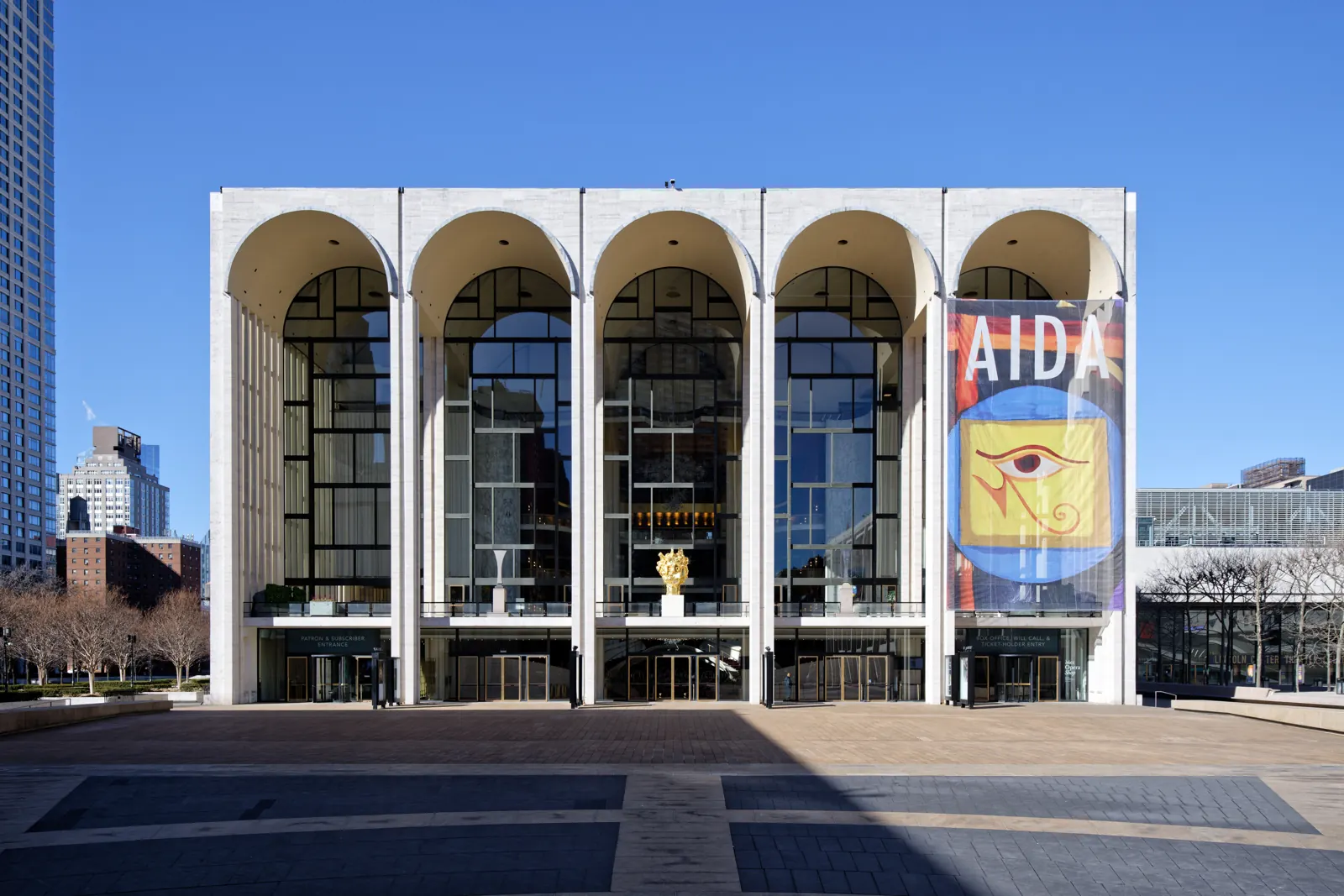
The Metropolitan Opera House opened on September 16, 1966, as the centrepiece of Lincoln Center for the Performing Arts. It is the company's home for every performance listed on this site, and it has been a landmark of New York's Upper West Side ever since.
A short history
- Architect Wallace K. Harrison (Harrison & Abramovitz). Construction began in the winter of 1963.
- Two Marc Chagall murals hang in the lobby: The Sources of Music and The Triumph of Music.
- The house hosted the MTV Video Music Awards in 1999 and 2001.
- This season (2026–27) marks the Met's 60th year at Lincoln Center; the Diamond Jubilee Gala is May 25.
- The first public performance was La Fanciulla del West on April 11, 1966, before the official opening.
- The house is the largest opera house in the United States by seating, with around 3,800 seats and standing room.
The lobby and the murals
Two Marc Chagall murals, The Sources of Music and The Triumph of Music, hang in the lobby. Each is about 30 by 36 feet. They are among the most photographed parts of the house, so arrive early if you want to see them before the crowds.
The stage and the machinery
- The stage is 80 feet deep from the curtain line to the rear wall.
- Seven hydraulic elevators and three slipstages, one with a 60-foot turntable.
- 103 motorized battens hang above the stage for scenery and lighting.
- Stage machinery lets complex sets change quickly between scenes.
Why the house matters
The Met presents a full repertory with a large orchestra and chorus, so the stage must handle very large productions. Its size is one reason the Met can stage operas that smaller theatres cannot, from Wagner's Parsifal to Verdi's Aida.